
Tim Kliphuis Interview with Nuno Marinho (August 2026)
Tim Kliphuis is a highly experienced musician and pedagogue who travels all around the world and is very knowledgeable about gypsy jazz, Django Reinhardt and Stéphane Grappelli's music, and its history... but maybe I'm wrong! So I sat down with him while we were touring in Brazil for what was supposed to be a quick 15/20 minute interview. Evidently, we lost track of time and were only interrupted 60 minutes later by Tim's alarm for us to go to the soundcheck. This is more than an interview; this is a journey through time, history, culture, and music. Meet Tim Kliphuis.
NUNO: Who is Tim Kliphuis, the musician and the person?
TIM: We just played exactly like you. And that reminds me of my five years with. Fappy Laffertin is the guru of the revival of the style. Gypsy jazz was created by Django Reinhardt and Stéphane Grappelli in 1934. It lasted until the Second World War, 75 years ago. And then, after the war, they got together but it was never the same again. So the real heyday of gypsy jazz is five years in the 1930s. And in 1953, after Django passed away very young, this was forgotten. The style was forgotten for two decades. For 20 years, nobody was playing. And so in 1971-73, Stéphane Grappelli, the violinist who did have a very long life.
He then ended up becoming famous again. And people suddenly remember, oh, these albums from the 30's with Django Reinhardt. So they go to their parents, they find these albums because Grappelli is playing for them on stages, at folk festivals, on television, and he starts becoming a household name. And so for gypsy jazz violin. He's the guy. And for jazz violin, improvised violin. He's the guy. And so everyone like me who is interested in trying to get into improvised music or rhythm music on the violin, something fun that is at the same time really challenging. They find Stéphane Grappelli, and I didn't find him. Grappelli found me because I got a CD on my birthday.
NUNO: Do you remember the first time you heard it?
TIM: I was 19, and somebody gave me a CD on my birthday. Stéphane Grappelli on violin and piano. I put it on, and the light went on in my brain because I knew I wanted to do something with the violin, but it was definitely not going to be classical. So I was studying classical music to become a good violin player, but I knew I didn't have the ambition to have a classical career because that was too restricted for me: playing other people's music and their notes, however great it is. And I've enjoyed my conservatory years immensely.
For a lot of people like myself, the door has been opened by Stéphane Grappelli. After that first CD, which was a contemporary album from the 80's/90s recordings that he made, I found out about the old recordings and his playing with Django. So when Grappelli got famous again in the 70's, Fapy Lafertin, Biréli Lagrène, and Raphaël Faÿs in France, those three people actually started pioneering again. They started relearning this music that Django had made by listening to the recordings. Mostly, people who were doing this were gypsy guitarists of the Sinti community, most of them, which is linked to the Gitanos in Spain, which is the gypsy tribe that came through North Africa and then up through Gibraltar. And that is a different tribe of gypsies than the ones who came through the Balkan areas. They came through Romania and Hungary. Those are usually violinists. And the Sinti community are usually guitarists, which is lucky for me because there were not so many good violinists when I started.
I'm from Holland; I'm Dutch, and Fapy lives in Holland, even though it's on the border with Belgium. He was born in Belgium, so he is technically a Belgian, but he's lived in Holland most of his life, and he is a very intelligent person who is self-taught. He taught himself to read. He taught himself to read music. He writes music. He knows about it. He teaches it. And that's quite exceptional in the Sinti gypsy community. So I was lucky to work with him for five years, and he inspired so many others. So we're looking at Angelo Debarre. We're looking at the Dutch famous trio, the Rosenberg Trio, who brought many new people into the style in the late 80's and early 90s. But Fappy is the guru. And that's what I was reminded of when playing exactly like you. He loved the old recordings.
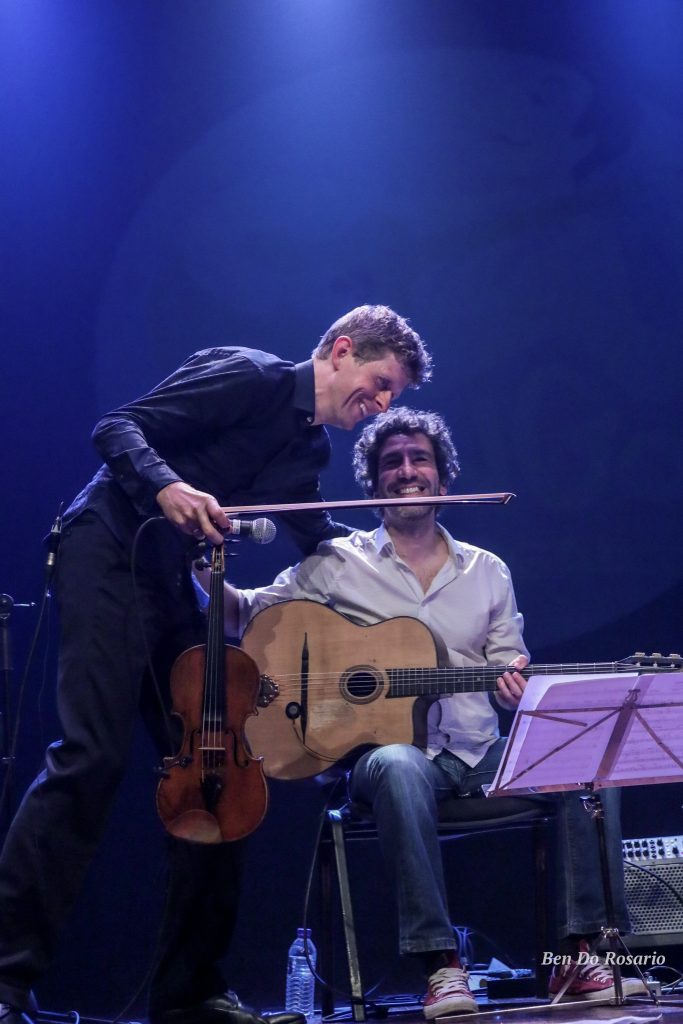
NUNO: You share this path from classical music to jazz and gypsy jazz, just like Stéphane Grappelli. And he also played the piano, and he was a composer like yourself. And Fapy, who is gypsy guitarist like Django, and he studied profoundly the music and the sound, the dynamics, the phrasing of Django. So it's kind of a revival of Django Reinhardt and Stéphane Grappelli in the XXI century.
TIM: It started in 1999 for me. So Fappy was already famous with Waso, with the band, with a Belgian band where he didn't only play guitar. He also played saxophone, bass and any instrument that he could. He plays many instruments. But when we played together, he wanted to go back to the old days, the 30's, where there was a quintet. So there were five people, so three guitars, not two, so two rhythm guitars accompanying only one lead. We played a lot of festivals where there were other fantastic players, but I think people always heard with us that it was a very respectful nod to the old days and always looking to make music. Fappy always wants to think about dynamics, about a nice line, about searching. He's a jazz musician, whereas some other guitarists in this style are more into the virtuosity and showing off their clever movements in guitar technique.
NUNO: Mastery of the instrument. I think especially guitarists.
TIM: That's true. But for me, mastery includes musicality. I think mastery is not the right word if you're just showing off.
NUNO: Technical virtuosity?
TIM: Yes! I would like to send a message to all jazz musicians out there on any instrument.
That virtuosity is great, and it's great to have a tradition that you can, like myself, the gypsy jazz tradition you can grow up in, you can learn from. You can sound a little bit like it. I mean, nobody sounds really like something else because we're all different musicians and different people. But once you've done that, and that was Stéphane Grappelli's advice to me, because I did meet him once in 1995 when I was just learning, and he was very supportive. I played for him, and then he said, Tim, you know, you're young; you need to play your own songs, your own music. I'm playing “Sweet Georgia Brown” for 100 years now, but I made this version of “Sweet Georgia Brown”. So it's my music. Make your own music. And I think that would be the message for people out there, especially if you're a great player, you can play very virtuosically. Please find something that makes you musically interesting. Don't just copy. Don't just play hundreds of notes per minute. Make beautiful songs. Try to make people cry. That's where the heart of the music is.
NUNO: Make poetry with your music.
TIM: Make poetry, and touch people's hearts. Fappy always did that. And for me, five years in his band gave me the chance to grow as a musician in this very close friendship with Fappy. We were very good friends and still are, but we worked together a lot, and he taught me a lot, and I hope he learned a little bit from me here and there about the more classical aspects.
NUNO: Everybody learns from you. (laughs)
TIM: Well, I don't know about that! So we're going on to learning and teaching now. I had a frustration when I grew up in gypsy jazz. So we're talking about the late 1990s. I would turn up at a festival or a jam session with my violin case, and there would usually be a band there, you know, saxophones, maybe drums. And it wasn't gypsy jazz. It was like jazz, maybe. And they would look at me with the violin grinding and making ugly faces. They would already be preparing themselves for a terrible experience. And there is a reason for that. So violinists were not very well educated in jazz, so they would expect from a violinist in a jam session to play only long notes, no rhythm. They didn't know how a song works, how the chords go, what the chords are. They couldn't syncopate; they couldn't make it sound like jazz, so they sounded like a classical person, like a singer going very “opera style”. But they're supposed to sing jazz. And that's like Frank Sinatra. That's so different. Or Peggy Lee. So it did become a mission for me to change that image of the violin, because even in my very first tour of England, which was after Fapy, when I went on my own. So I kind of broke up with the band, and I had to find my own path, as Grappelli had said. And I was offered a tour of the jazz clubs around London and going into northern England. So it was a tour of eight clubs, but I was a big unknown. Nobody knew my name, and so the owner of the club said, “you can come and play, but we play with a local rhythm section, so you get piano, drums, and bass and you do your thing with them. Don't bring your own musicians who don't have the money to pay for that”. And that still happens a lot in the jazz circuit: they bring a soloist over who plays the local rhythm guys. And maybe the week before I came, they would have worked with Scott Hamilton, a fantastic saxophone player, or,Roy Williams, a fantastic trombone player from England. And then they saw me and the same reaction: “Oh no... violin player.” So I had to do something. I had a trick I developed. I would play something like, " Exactly Like You, " or I can't give you “Anything but Love,” a medium-tempo song. And then my second song was “After You've Gone”, which I started slowly (music) And then at the end of this first chorus, I would get a break. I would ask them for that. And then suddenly they had to play very fast. The drummer had to drum fast. The pianist had to play.
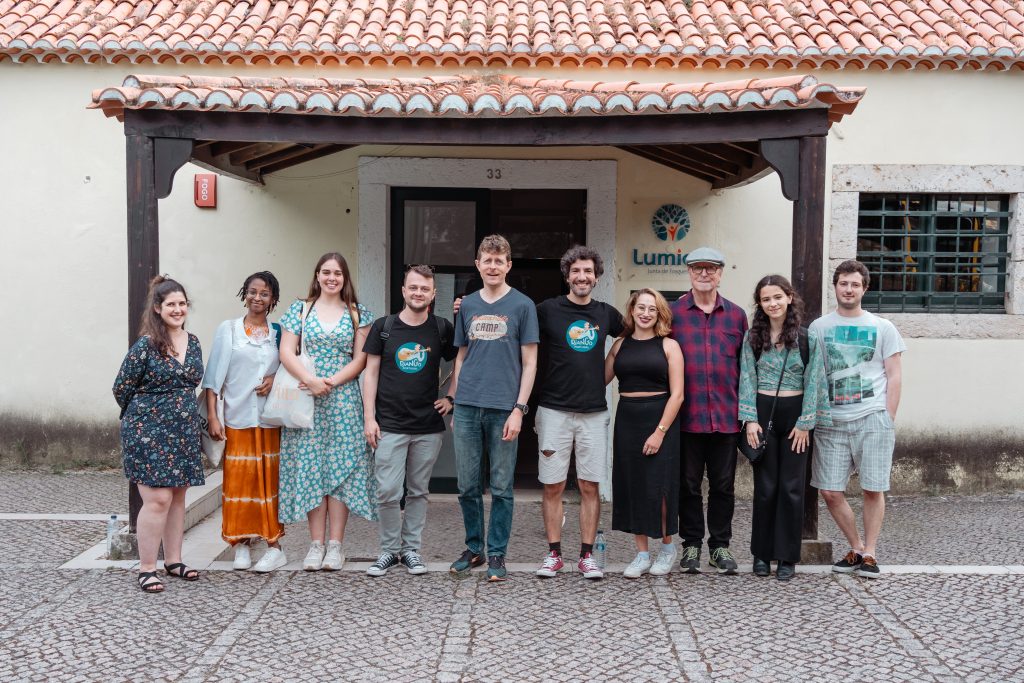
NUNO: They weren't expecting the fast pace.
TIM: They were not expecting that. They were expecting a mediocre concert. So suddenly, they were my biggest fans because I kicked their asses. But how sad is that? That you have to prove yourself in such a mean or trick way for them to respect you. So this became my goal. Let's change the image...
NUNO: To be mean? (laughs)
TIM: No, not to be mean!! Maybe a little bit here and there (laughs). No, no. Absolutely not. I'm the opposite of mean, actually. But I liked your comment though. I'm going to think about that. That's maybe good advice. So, to change the image of the violin so that people no longer respond to a violin in jazz like that. And that means that everybody who's playing jazz and wants to play jazz has to learn stuff and has to be informed and has to practice. Right. That's been a mission since 2004.
NUNO: And jazz is open to all instruments. The violin is not only a classical instrument.
TIM: Or a folk instrument. Don't forget, worldwide, the violin is – after the guitar – the most versatile instrument. It's in tango. It's in Romanian, Hungarian gypsy music. It's in the Arabic tradition. It's in the Turkish tradition. It's in Irish, Scottish, American fiddling; you know, you name it, it's there. Old Dutch folk music has violin in it. And then it has all the classical music, and then there is violin in pop music now all the time as well. So it's the second most versatile instrument after the guitar.
NUNO: It's small, it's portable. You can fit into any situation. So it's easy.
TIM: Because of the link with classical music, the violin also has a kind of element of being a bit classy, maybe, I guess. And I love the instrument, so I love promoting it. But my students, I really work with them on practicing properly, understanding the music properly so that when they go to a jam session, they don't reinforce this bad image of the violin where you don't know what you're doing. They sound right; they swing. And so that brings us to camps. I started the Grappelli Django Camp. Remember, the name Grappelli is first. Because it started with my students. Also because people often forget Stéphane Grappelli. So I want to actually give a shout-out to Stéphane Grappelli here in the history of Gypsy Jazz. He plays a leading role. People who play the guitar like to focus on Django Reinhardt. But gypsy jazz music is not guitar music. It's guitar and violin music and double bass. If Stéphane Grappelli had not met Django Reinhardt, we would not know Django Reinhardt. He would not have been famous. He would not have made any records because he didn't want to.
NUNO: Also, one influenced the other creatively.
TIM: Absolutely! I do have to say there was a difference between the two. Django was a self-taught genius. He really changed the history of the guitar. He changed the history of jazz music, even. Stéphane Grappelli was not that type of genius, but he was this mega super talent you see every once in a hundred years on the violin. Without jazz training, but with some classical training, he managed to keep up with this genius of the guitar and inspire Django to play better, to have good endings, not make a sloppy song, then to go into a recording studio when he didn't want to. Then to find him when he was playing pool, when they had to play for the French president. He was not an organized man, and Grappelli really was there for him in this part of his life.
NUNO: Grappelli provided a structure to Django.
TIM: A professional structure and a musical structure. How are we going to rehearse this? We need an arrangement. We need it to be nice and tight. So the class and the perfection is definitely, I would say, more than fifty percent. Stéphane Grappelli, Merritt.
NUNO: And even the way the band was sometimes introduced, because of commercial purposes, or the name of a violinist had to be first. So Stéphane Grappelli and his band with Django Reinhardt in the middle.
TIM: Well, I have a nice story about that from Martin Taylor, the guitarist who was in Stéphane's band for 11 years. And so he got all these stories. Stéphane told him about how they reunited after the war. As I was talking about, sometimes the 5 years stopped. Then the Second World War saw Django in France and Stéphane Grappelli in England. They reunited, and they played together, and one of the shows was in London at the Palladium, I think. And because Grappelli had lived in London and played for the troops with Vera Lynn (interviewer’s note: Vera Lynn was a British singer known for her recording of “We'll Meet Again”) and for other famous people, he had become a little bit of a famous person in Britain, a household name. Django had not been in Britain for 5 years. They started getting famous, but then the war stopped that. So they walk up to the venue, Stéphane Grappelli and Django Reinhardt, and he gets mad. Django does not want to play, so Grappelli. Thankfully, with the gypsy tradition, the Sinti tradition, if you're older than someone, they have to respect you and look up to you. So because Grappelli was born in 1908 and Django in 1910, he was two years older, so Django actually had to accept sometimes when Grappelli made a decision. And that saved the situation because he brought him in, and they were sitting on the stage. And in those days, you had a curtain on the stage. The band would be ready, the curtain would rise as the band was playing, and that was like a cinema kind of approach. So they're sitting there, they're going to play their first song, and Django doesn't want to play because he's still upset that his name's not on top. So Grappelli has to kick his chair because the curtain's going up, and it feels like an hour of silence, you know? Django is not starting, so Grappelli kicks the chair, and Django looks back, he grinds his face, and starts playing. And of course, everybody starts smiling once the curtain is above their heads. Nobody in the audience knew, but Grappelli had to be his babysitter. Sometimes that must have been really, really hard for Grappelli. And I know that Grappelli had a sort of love-hate relationship with Django. Not hate, but a difficult relationship. But when he talks about Django in his interviews and his stories, there are some funny stories. But also, he had a great love for him. So it was a unique partnership. But again, shout out to Stéphane Grappelli, because also, if he hadn't started getting famous again in the 70's, we wouldn't be sitting here right now. Nobody would be playing this music. So thank you, Stéphane Grappelli, for bringing gypsy jazz into our lives again.
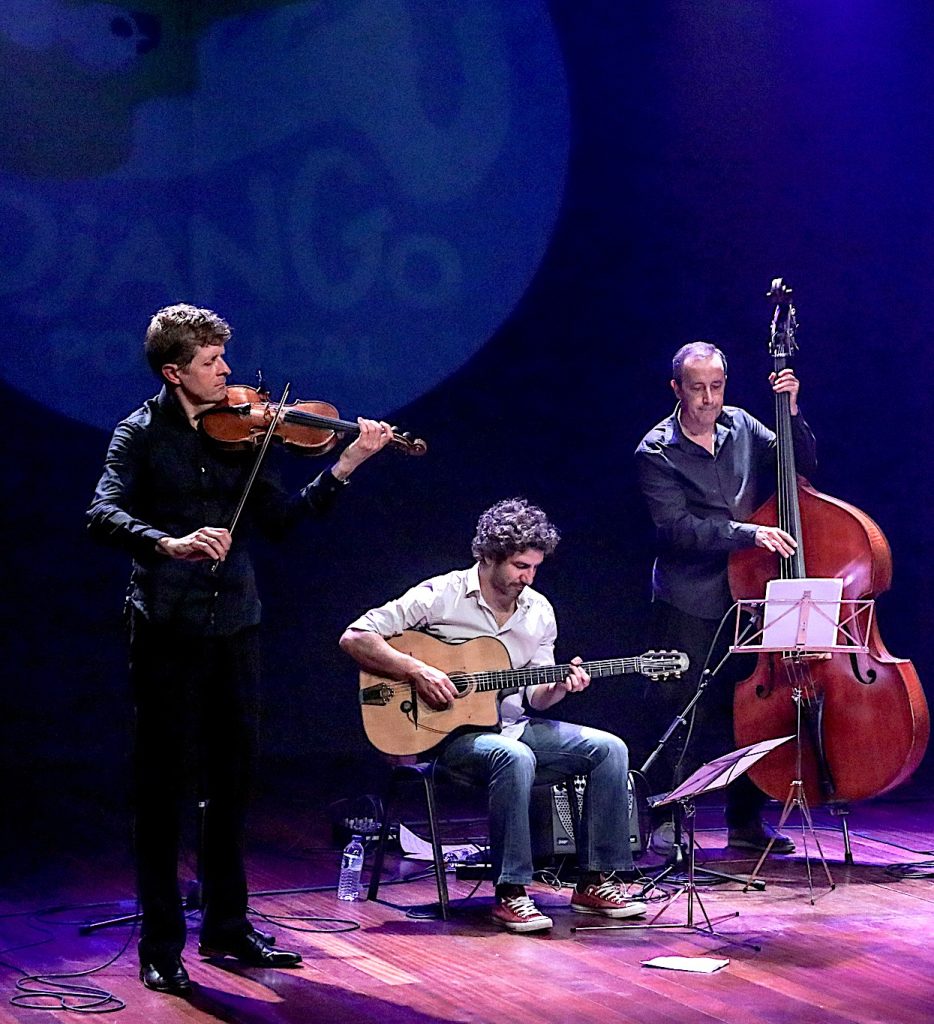
NUNO: And thank you, Tim, for all the camps and touring. How is it going? We were talking about the Grappelli Django camp. You started this in 2010? And double that, because you have the summer camp and then the winter camp. You're the only guy organizing 2 camps per year. And you're the guy who's bringing a lot of violinists into camps to specialize in this music, but also a lot of guitar players.
TIM: We have turned it around a little bit. So normally the ratio is 2 or 3 guitars and 1 violin. With me it's 2 violins, 1 guitar roughly. Or ideally 3 violins and 2 guitars. That's a nice balance for the jams so that the violins all get the chance to play. But if you only have a few guitarists, that's no good because the style needs the energy of the guitar. So we have around 40 guitarists and 60 violinists in the summer, and in the winter it's a little bit smaller. We sell out, but we don't grow. We keep it here. Because it has to be personal for me. I have to basically see everyone and help everyone out a little bit. Even if I don't get to work with everyone during the weekend. But I need to address people's questions, because of the experience that I've had during 26 years of teaching now, or even more.
NUNO: Through classical music, jazz, gypsy jazz, and folk music.
TIM: Yes, my teaching has really always been on jazz violin. And that's no different than gypsy jazz because good gypsy jazz is good jazz. So you have principles that you need to learn. You have sound issues; you have to deal with your instrument. You have to learn how to use the bow in a jazzy way. And those are all things that everybody also, Jean-Luc Ponty, who was a jazz-rock star and is now retired. But I'm friends with him, and he is a very humble person. I can sometimes never believe how humble he is because he is so famous. After Grappelli, he blew up and became the biggest thing in the world, playing to stadiums. So he was even more famous. But with the electric violin and even Jean-Luc had to learn the same principles that I'm teaching the gypsy jazz students. It's not different. He has some innovations, and we learn from him, for instance, how to use ghost notes (music). So that's a violin style, which is related to the breathing of saxophones. It's related to ghost picking on the guitar. That's Jean-Luc's big innovation. So Grappelli didn't do that so much, but you need to learn the good things.
NUNO: You did some innovation yourself. Like the comping style. Let me just say that, truth be told, you are one of the best – if not the best pedagogue – in my opinion, alongside Tcha Limberger. Well, sorry, guitar players, but the violin guys are much more structured. I had the privilege of teaching alongside the two of you in January 2025, at the Grappelli Django Camp winter jam. I was amazed. I have these two amazing musicians, the best pedagogues in the genre. How lucky these students are to be able, in just a weekend of 3 or 4 days, to get such an amount of inspiration, knowledge, and experience. To me, that's really special and unique what you are doing. And also those specific techniques that nobody was actually doing. And now a lot of people want to start doing it just because you are showing that the violin can be used to do more, even more.
TIM: Yes, the accompaniment on the violin. That's what you do on a guitar naturally: playing chords, and the violin is a melody instrument. But the reason I had to do this was that Stéphane Grappelli, in his later years, played always in trio. So he had the violin, the guitar, and the bass. When the guitar had to play melodies or a solo, most of it would be chords, and the bass would be accompanying, and that was it. But it was all about Grappelli-
NUNO: Which Is really hard for the guitarist to transition from the La Pompe comping to a solo with harmonic support.
TIM: Grappelli always had fantastic bass players. So that was never a problem. And they were always the highest-level players. I mean, Martin Taylor I mean, you don't have to explain why he's fantastic. And so, that was, though, very much about Grappelli. So he would play maybe six times as much as Martin Taylor as a solo soloist, as the melody player. So the accompaniment for Martin Taylor was not too much a problem. He's a fantastic chordal player, so he could play anything; he could play by himself. He would not have been a problem. And he does. But in my band (which was the same lineup: violin, guitar, and bass), my guitarist and I had a one-on-one relationship, so it was not about me; it was about the band. So we both have equal time playing solo. And I thought, well, if he's playing so much solo and he only has the bass, that's not good. We need to add something.
NUNO: And also it's boring for you to stand outside of the band waiting. If you're also comping, you can always participate.
TIM: Absolutely! So for me, the steps were very, very careful because I had seen how, if people played during somebody else's soloing and they tried to accompany, it's bad; it hurts the player. So it had to be good. And so for me, I started thinking back to my time with Fapy and thought the way of playing the gypsy jazz accompaniment is actually too heavy for the violin. So I can't try and do that. But I also played with some very, very fine jazz guitarists. The one who resonated most with me was called Bucky Pizzarelli, an American Player, who was in Grappelli's band in America in the 90's. There are recordings of him with Barney Kessel and Herb Ellis, who are two older names who worked with Oscar Peterson a lot. That style of accompaniment, where you have a new type of accompaniment every chorus, so that you're building an arrangement that really appealed to me. So I started learning and thinking about how they sounded. And trying not to be too loud, but to be soft, but very punchy. And so I leaned on my bass player. I was going, okay, I'm new at this. So in my band, I will start accompanying like this, but I will always listen to the bass. And if I'm not together, it's my fault. That's a decision I made. So I learned while we were doing this, and I was learning, I always was the one who was going to adapt if something didn't feel together. And gradually you build up a repertoire and a comfort, and then you start getting good at it, hopefully. And so now we are one-on-one, my bassist, Roy, and myself, or if I play with another group with one bass, I know from experience now what to do. So fast forward to the teaching. People are saying, how do you do this? I want to do this too. And then I say, well, if there are many guitars in the group, don't do it because there's already too much accompaniment.
NUNO: And nobody will hear you.
TIM: Or they will, and then you'll be too loud (laughs). So it's especially if you're on your own with a bass player and you're accompanying somebody else. And that can be really magical. So I try to, to help them out a bit. And the most important thing is, of course, rhythm has to be always steady. It cannot get slower and slower because that is killing.
NUNO: The energy has to be there.
TIM: People's hearts really die when they're playing, and somebody is taking the tempo down. Also speeding up. Not so good. Less bad, but still not so good. To learn to do that is yours. So, in concert, I would say don't start too early with the accompaniment and learn a lot. Spend a lot of time and play with good players who you say they're right, I'm wrong. And you always listen to them, and you try to fit your music in there. So that's a new style. It's a new thing. So you can call that innovation, I guess.
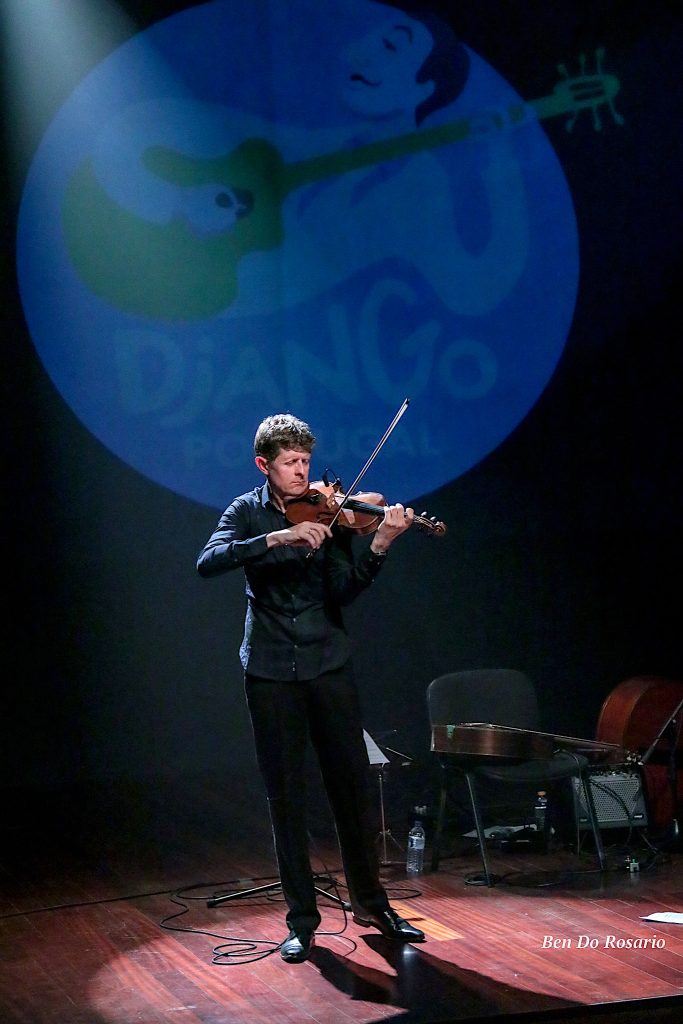
NUNO: What about festivals? You've been at Django Portugal in 2023. How was it for you?
TIM: I loved being in Portugal because, for me, it felt like what you're doing there with your festival; it feels like a sort of new start, like Portugal is starting to wake up very gradually to this music. Musicians are starting even slower to wake up to this music. So for them, it's mind-blowing to hear about improvisation on this instrument, on the violin. And you, of course, have made a study of this music; you show a lot of respect to the style. You have a lot of ability in Portugal to help people grow. So you're also a teacher, and that's why you came to my camp? I loved that it felt for me like my presence there was really, in a way, impactful.
In the same way that now, speaking from a Brazilian hotel room, it feels like my presence here is really impactful. There are violinists, one or two here who are really fine professionals, but I can help them a little bit because of my experience. I get questions, and they listen, and they take things home with them. I love that it helps someone. Of course, I play because I want to play for audiences, but if it helps a violinist to hear me like it helped me so much to hear Stéphane Grappelli- to see him on the stage. How does he do this? What does he look like? What is he wearing? You know, all those things, they're super important. Not just the playing. So I really love that because, for instance, in America, everybody is doing it now. Every city has a hot club band or two or three or four.
NUNO: Gypsy Jazz is very popular in the States nowadays.
TIM: Absolutely. And in the Far East, it's also getting quite popular. So there's now the Taipei people and there's people in Japan doing it, and there are people in Korea. So it felt for me in Portugal, it's really time that people wake up more, and also the audiences, because there's a big potential there. Because the music appeals to a lot of people.
NUNO: From my perspective, I had roughly 10 to 12 years of doing this professionally and exclusively; I left everything behind the legal career, jazz, and all this stuff just to focus on this: Django Portugal Festival and Camp. And the audiences are growing a lot. Also, the venues are opening more doors, and there are more people interested in listening to the music, more students or professional musicians. I used to be a professional musician in other areas
TIM: They started the crossover.
NUNO: I had a kid learning from me since he was 17, and now he recorded albums; he's singing, he's playing blues and slide guitar and completely unrelated to jazz or gypsy jazz. And now he went to France just to buy a guitar. And he's obsessed. “I want to do this. This is so exciting”. And he's already a fantastic musician with a professional career. So, to be able to host guys like you and Tcha Limberger and Sébastien Giniaux and all the guys, we're always learning, we're always being inspired. And we are sharing the opportunity to get you guys more and more knowledgeable in Portugal in this case, and hopefully a little bit more in the world.
TIM: Yeah, I really thank you for that because, myself, I organize camps, and I curate a violin festival which has all stars, violin, everything for the whole world. And it's in Holland as well. But I don't organize the Festival. It's organized by the National Violin Competition, and so I am not an organizer of concerts. I'm not a concert promoter, so I'm always very grateful when the chance is there. When somebody like you says, " Come, I have 2 concerts; come and play these here. This is going to be here, this is going to be there, this is how it's going to work". And then I'll say, okay, this is how it's going to work musically. But the collaboration between somebody like myself, who I'm pretty organized and I have my camps, and they do well, and I organize teaching online and everything pretty well, but I have the biggest respect for the promotion side of it, which you also do, not just playing music or teaching. Because without that, none of us would be playing. And I think, going back to Portugal, it's a country that has a lot of potential, a lot of growth possibilities. So if I can help a tiny little bit there by, you know, introducing a few people who really love the concert, then they're fans for life. Last night, I played with a Brazilian mandolin player called Victor Angeleas. He and I met two years ago when I was here, and I saw him, and he knew about my playing because he'd been listening to Fapy Lafertin's band. I heard him for the first time, and we connected. We said we should play together. And so after this, we're going to his place in Brasília. We're going to Goiânia, and we're going to build on what we did yesterday for the first time, which was playing violin and mandolin. Who comes up with that combination? No bass accompaniment. Nothing. Just those two small high instruments. And it worked.
NUNO: That's how it starts: Collaborations.
TIM: The collaboration with him is about learning his native music, which is Choro and Forró, which is Brazilian folk music from 100 years ago. And to learn how he accompanies, which is very different from me, although he also knows about jazz. But in his jazz accompaniment, he has the elements of Brazilian folk music, which sometimes is, for me, quite complex rhythmically. So I have to learn to deal with that, and in doing so, it makes me a better musician. So that's what collaboration for me is about. If you can both learn something from the other.
NUNO: You're coming back to Portugal in October 2026. What's going on?
TIM: Yes, in October, I can't wait.
NUNO: October 30 in Lisbon, Fábrica Braço de Prata. And October 31 in Coimbra, Salão Brazil, which are two great venues. They both appeal to different audiences. So that's also a good thing. Back in 2023, especially in Coimbra, if you remember, we had a huge crowd. When I opened the curtain, the room was completely packed. It was mind-blowing! What is going on?
TIM: Yeah, that was a very special concert that I remember very fondly.NUNO: It was great. Now you're going to play in a trio, and we'll have a great time.TIM: I'll accompany you. We can practice that.
NUNO: Exactly. Do you have any specific song that you like, your go-to song or q favorite composition from Django, from Grappelli, from yourself?
TIM: Well, I have one of my compositions, which has become a bit of a surprise success in a way. It was written about my middle child, and it's called “Samba for Pay”. We played it yesterday in duo, and a lot of people said, “I want to play that”. So this song is now leading its own life with other people performing it sometimes. That, for me, is a very special thing when other people take the song that you wrote, and I hadn't written it with that in mind, because it's from a 2010 album with my trio called Acoustic Voyage, and we played it with percussion and in a sort of a Brazilian Samba way, but now it's found its way into gypsy jazz. So it's a different accompaniment type, but it works. And so it was not planned. And that's very special for me...
NUNO: Grew its own identity.
TIM: Yes, and I think Pay is very pleased that it gets played also in my camp. I've played it once or twice when they were there. So that feels very, very special.
NUNO: Your music, your personality, your example, the way you conduct yourself, the way you present yourself musically.
TIM: The shirts!
NUNO: The shirt, the hairstyle, the shoes (laughs). You know what I mean. It's such an inspiration to us all. To students and audiences.
TIM: Thank you. I'll take that win. I'll take that compliment.
NUNO: Yes, you should. Any advice or any last-minute idea that lives inside you, that you can share?
TIM: Yes, I would. I have something for the musicians to share. I heard yesterday somebody had been to my new friend, my new friend Victor Angeleas, the mandolin player, his workshop, and Victor was asked, " Do you have any advice? And he said, " This was about choro. So, traditional Brazilian music. And his advice was, yes, learn the melodies of two hundred choros. And then the learning starts. So that shows how big the journey is. You have to learn 200 songs. I like that number because I'm sure for me it didn't really start happening until I had 200 songs. Of course, when I tell people who start playing, yes, learn 10, make a list of 10 songs, but then work on them, make them good. That would be my first advice. There are two parts to this advice, but my first advice would be to put in the hours if you want to, and you know about this, you've done this. So if you want to.
NUNO: I'm still doing it.
TIM: We're all doing it. I do the same.
NUNO: Learning never stops.
TIM: No. Learning is forever. Thankfully, we can stay children until the day we stop playing. And that's the best thing for me about music careers is that we don't have to grow up. And we can still be childishly excited about a new song. If you look at it from far away, it's just a new song. What's it going to be different than the other songs? But we get excited about it, and that is childish. It's naive, and it's a naivety that is super important to have when you're an artist. And that's the same naivety that, if you're an artist, Picasso was like a child all his life, and I'm not sure if I'm a fan of him as a person, but in his art you see this also the development, always finding something new, always seeing something that inspires you. So that is the journey of the artist. Once you've learned and done your work, and you keep doing your work and you get an experience where you play somewhere and you think, " That didn't go so well. I need to fix that. Always working towards getting better.
NUNO: That's funny you said it as a 1 advice: learn 200 melodies, and then the real learning starts. This thought is not very popular because everybody just wants a quick fix and shortcuts.
TIM: On the internet, everything is like “learn gypsy jazz in three days,” and we can pretend that's possible. But it's not.
NUNO: It's not. Some years ago, I recorded a clip teasing the guys because everybody was asking me, “How do I memorize 200 or 300 songs”? And my response is exactly this. Do you know 200 melodies? So why do you need to know 200 chord progressions? Start with the melody because the melody gives you the chords. In order for you to learn, you have to put in the hours. And what you put in the hours sticks to you. It's not the number of hours. It's what you put in the hours.
TIM: Yeah. Well, some people are more efficient at practicing than others. And I try to help people be more efficient because life is short. We don't have so much time on earth, so we need to make the most of it.
NUNO: You learn what is meaningful to you.
TIM: Yes. And that's the second part. The 1 part is: “Do the work. Put the hours in”. And we're talking about this figure that somebody came up with in the 80's or 90s: 10,000 hours. You have to do it to get good at something. I would say 10,000 hours is the start.
NUNO: Malcolm Gladwell's book “Outliers”.
TIM: There you go. That's the man. I think that's the start to get to the level of, let's say, if you're a master's student, but the word student still applies. So to be a master, you need many more. But that happens during your journey. So for me, when I started playing with, I had done my 10,000 hours outside classical, which was also 10.000 hours. But then I wasn't a finished product, and I never will be, thankfully. So then you start learning other songs or different repertoire, or you work with other people and it asks different things from you. And so that development goes on all your life. But the second thing you need to do is, and that's the advice that Stéphane Grappelli gave me when he said, play your own music is to be a music personality.
So that's it relates to what you just said. Which songs do you like when you do your 200 songs? Which ones? And that also defines who you are, and how do you play on those 200 songs? So the second thing, which is just as important, even maybe more important, but you can't not do the one and do the other. You have to do both. But that is that you, you think about the artistry side. So you become an artist. And that means that you have to create art, and that you have to think about: how do I play for people? How do I make them smile? How do I make them cry? And if you can't do that, something is missing from your art. And if you are missing something from your art, your job is to find out what and how to fix that. And I firmly believe that everybody who has put in a lot of effort has a basic talent.
Of course, we do need some talent because, for me, I could work 20.000 hours on the piano. I would still be crap. So I know that, and I have enough work in my life just with the violin. I hugely respect people who play multiple instruments, but you find your own path that's different from somebody else's path. And that creates an opportunity because then you can say, I do this. That's different from what they are doing. That means that maybe it's nice to have me in the concert next time because you've heard them. So that creates a career opportunity when you're still just copying somebody else. It's not going to be a career.
So for me, my career really started going when actually that was the final step. I stepped out of gypsy jazz, started working with classical musicians, with orchestras, but with improvisation. And I've brought gypsy jazz into the classical world, but have had to change it because, to go only with gypsy jazz repertoire into the classical world, people would not have connected. So my actual career is right in the middle between those two styles. My two loves are classical music and gypsy jazz, and writing music, playing music, playing with classical people, with gypsy jazz people, and bringing those two worlds together. So that has been my artistry, and that has given me my career, which is a lot bigger than if I'd only stayed in gypsy jazz. Which is funny because first you think: “But where do you play? If you combine two styles, you can't play in the classical world, and you can't play in the gypsy jazz”.
NUNO: But it gave you an identity.
TIM: It does give an identity, and it has taken me 2 decades, I would say, nearly, to start really feeling that I've been a pioneer of breaking the wall between these two things, between improvisation and classical music.
NUNO: Thank you for that!
TIM: This has always been a goal, but it's taken so long and so much hard work. But I can now say there are lots of people who are doing stuff like what I've done, and they have a much easier route now because people like me (Roby Lakatos is another one) have broken the boundary a bit. In music, this has always been connected, in Mozart's time as well. So we've lost that a little bit in the 20th century. And, I'm sort of hoping to repair a little bit of that and bring audiences and musicians more together. So that's my choice. And that's totally my own choice. I don't want to say that everybody should be doing that.
NUNO: Everybody has his own path.
TIM: Exactly. So find your own path, be your own artist, and make sure that you have the background, the practice, the hours that you're good at, and you can do this. You understand what you're doing? Long advice. Sorry.
NUNO: Yeah. Thank you so much.
TIM: So many words. My advice to myself next time is “use fewer words” (laughs)
NUNO: Make it shorter. (laughs) Dude, it's unbelievable. An honor and a pleasure to be part of this world, you know? And just a quick story. Last night, Sebastian Giniaux, one of the greatest guitarists, and I were riding on the back of the car, while Florian Cristea and Tim Kliphuis were leading us in the front. So that, to me, is amazing. What a communication, brotherhood, art, or poetry between guitars and violins. We share the stage, and all of these experiences and the community are so rewarding. So inspiring, and helps us grow and be motivated to keep pushing forward and finding new paths. So thank you so much for everything. Do you want to just play something to cry or to laugh?
TIM: Let's play “Je Suis Seul Ce Soir”. (music... and a few moments later) Oh Christ! That's my alarm to be ready to pick up because I have to soundcheck. Shit! You have to fade this out. That ruined a perfectly good take! (laughs).