

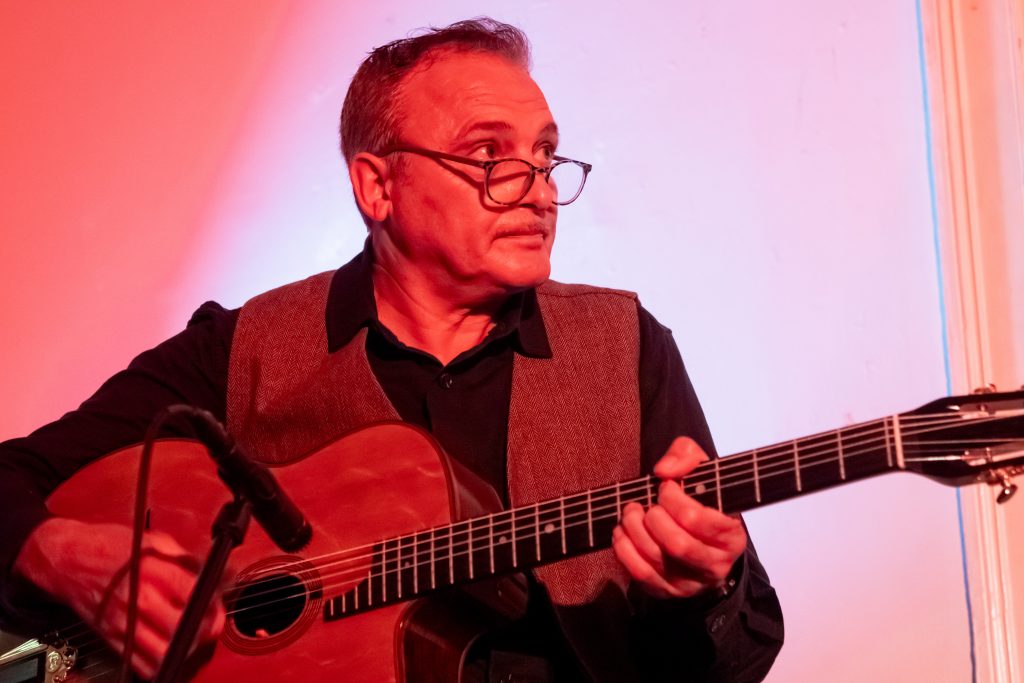
Lollo Meier was recently at the 6th edition of the Django Portugal Festival. The living legend of Gypsy Jazz, who had already been scheduled for 2024, recovered from a serious health problem that kept him from traveling then. Now, in great shape, Lollo Meier recounts his experience.
Who is Lollo Meier? The artist and the person.
I am Lollo Meier and I am of Dutch and Belgian Gypsy descent, and I speak our own language, the Sinti language. But I was born in the Netherlands.
In my younger years, I only played Django Reinhard's solos. And over the years, I have developed my own improvisation and style. In the style of Django. And then recorded various CDs with many of my own compositions.
From all the praise I've got through the years, one of my proudest accolades happened in 2013. I participated in a songwriting festival in Nashville. Out of 15,000 entries, I came in 12th place with my composition “Le quecumbar Waltz”, named after a Django Reinhard bar in London.
Do you remember the first time you listened to Gypsy Jazz?
When I was 8 years old, I played the accordion; when I was 12, I heard Django Reinhard on an LP for the first time. Since then, I have been playing Django's music in my own style and improvisation.
What does it mean Gypsy Jazz and Django Reinhardt to you?
The name Gypsy Jazz came about because many guitarists used Rumba rhythms and many redundant chords because they wanted something different. Django Reinhardt is independent of this!! He never played Rumba. Django played in a large jazz band without any problems, because he used the original chords as they were on paper and as the composer wrote the song! I personally think that if you play Django's music, you must also incorporate his rhythm; otherwise, it is not his music. The rhythm determines everything about the music.
For somebody new to the genre, who should they listen to first and foremost?
I think of Django Reinhard's music and Django himself as a God figure to all guitarists in the world! What Django played in the 1940's is what they call modern jazz today. So, as a musician, it is recommended to study Django's music first, so you can understand what jazz is all about.
You've been collaborating with many artists. Can you tell us more about how they happen and any great (or funny, or inspiring) stories you can share?
I have played with many famous guitarists on various stages all over the world. That is because a Django Reinhard festival is organized worldwide. And usually, they ask a famous Sinti guitarist to welcome the audience! And that is also how it comes about that I make friends with other musicians and we all play together. The ones I always mentioned are, of course, Fapy Lafertin and Tcha Limberger.
You played at Festival Django Portugal. How was it for you (the cities, the venues, the audiences, the music scene)?
I enjoyed Festival Django Portugal so much! It was super well organized with an interesting audience that greatly appreciates the music! I played with high class local musicians and hang out with the guys who organize the Festival themselves. I developed a special friendship with Nuno. I've spent a few days at his place and we had delicious meals together with his family. And afterwards I got the chance to visit the beautiful cities a Lisbon and Coimbra. It was very special to me.

What are your plans for the future? Any albums, tours or collaborations scheduled?
My plans are to further promote beautiful music in the style of Django Reinhardt. I have composed some new songs that haven't been released yet. I am going to record them at my leisure in the studio on CD this winter so they can be released publicly.
Name your favourite album of all time.
Nowadays I don't have any favourite CDs to name. But if I must, I'd choose Django's Rome Sessions in 1949. With Django Reinhardt (g); Stéphane Grappelli (v), Gianni Safred (p), Marco Pecori (b) and Aurelio de Carolis (dm).
Your music and work is a source of inspiration for so many people. What inspires you the most? Can you tell a moment in your musical career that changed everything for you?
Yes, my music and work are a source of inspiration for so many people. For example, I often hear other guitarists using parts of my solos. Or, for instance, a Waltz that resembles my work. There is nothing wrong with that! It just means that my own work is on the right track. And that many musicians like it.
I hope I can keep making music for a long time. Soon, in the wintertime, if all goes well, I will start thinking at my leisure about how I will record compositions for CD. We will keep you posted. I'd like you and everybody in Portugal to be the first to hear it.