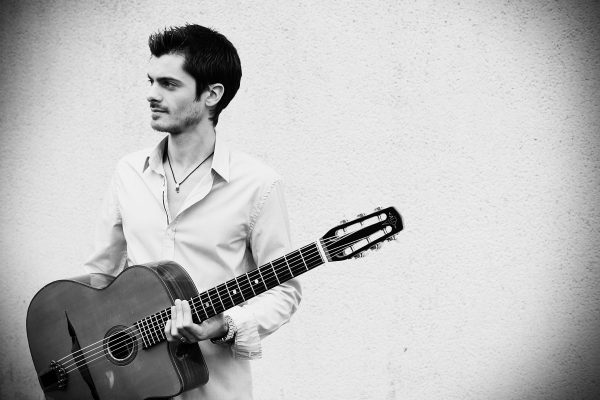
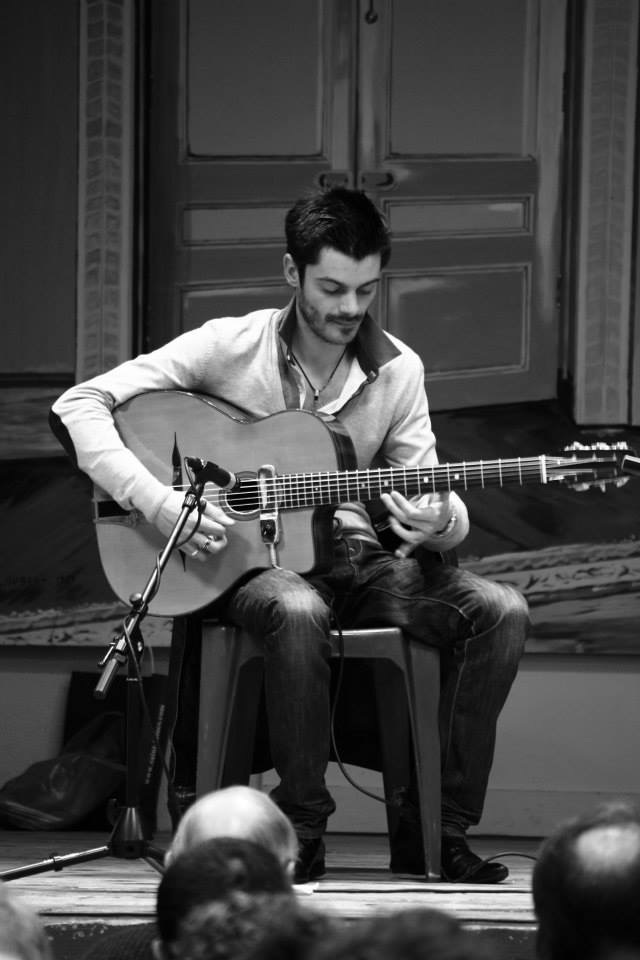
Adrien Marco is one of the new wave Gypsy Jazz talented musicians around, and he is currently crowdfunding his second studio album. He’s a very humorous, cheerful, and delightful human being who is playing Django’s music and adding original tunes to his repertoire. Here’s a pleasant and fulfilling meeting with Adrien Marco.
1 – What has inspired you to play music?
I started by playing guitar. I saw a guitar in a friend’s bedroom and I asked him if I could try it for a few days: “Can I borrow your guitar for a couple of days?” – I said. “I would love to try it, but I’ve never played before!” Nine years later, I still have this guitar at home with his agreement, of course. When he saw that I liked it he offered me his guitar.
I remember the first evening after bringing the guitar home. It was like Christmas Eve. I don’t know why, but I felt like I wanted the next day to arrive faster, just like in Christmas Eve. I wanted to start playing to discover this instrument. The first time I played some chords was magic. The feeling I had, the sound, the vibration … I loved all about it.
5 or 6 months later, I heard Stochelo Rosenberg playing “Ou est tu mon Amour?” In this moment, my eyes were filled with tears (a looooot!) and I said to myself, “I want to do this music”.
Later, I heard Django playing, and I thought the same thing. I used to listen to a lot of music when I was young: Funk, Toto, Police, Scorpion, Hip Hop, Italian music (my origins), but I never heard this kind of music before… Jazz Manouche. I felt I could relate to all of the emotions Django explored in his music because that is who I am. I told myself that I needed to play this music. The feeling was natural to me.
2 – What has influenced you over the years?
Nowadays, Italian music (or so-called Italian-American music), Django Reinhardt, and Jazz influence me. But I also listen to Hip-hop (for instance, Gangstarr, or even non-acknowledged DJs). I listen to a lot of different styles of music, but for me they are all one thing only: “Music”!
I can’t actually read music scores. I just play by ear, listening and seeing other musicians playing. Later on, some gypsies came to me and we became friends quickly. I also learnt by playing with them. For me, playing with ears and heart is the best school.
3 – You’re currently fundraising for the release of your newest album. What can you tell about the project and the music?
With the recording of this new project, I focus on my musical influences, just like I did on the first album, but I aim to go beyond. In this new CD, I want to reveal who I am, so we play Italian music covers in a Gypsy style. We have some surprises for the public! We also play Italian-American music, original compositions, and of course, Sinti music because this is the music that has been in my heart since the beginning.
It was time for the Trio to record a new project and to have a new album, containing all the new things we had worked on after the first record in 2013. We will work hard to create something special and typical coming from Adrien Marco Trio.
http://www.kisskissbankbank.com/fr/projects/adrien-marco-trio-nouvel-album
4 – What motivated you to keep practicing?
To be able to play whatever I want. That’s what continues to motivate me. Today, I see music not just as a hobby, but as a part of me. I see the guitar as a continuation of me; I see the guitar as a part of my body. I also feel the urge to play, to feel vibrations in my body, to feel the left hand on the guitar.
5 – What were the biggest challenges you have faced to progress in your practice, performance, and musical career?
The right hand is one of the biggest challenges for playing this music 🙂 I did a lot of targeted practice for my right hand. And the other challenge I find VERY important is to get good sound and play with heart and passion. This music can’t be played without these elements.
6 – Do you remember your practice process when you started playing?
I used a weight for the right wrist at the beginning. As you might imagine, it was impossible to play comfortably, but I wanted to practice with it to play more loosely afterwards. I started understanding a lot of things with this method, but it’s hard to explain. Precision, regular motion… It was my method during some months, the first months.
I also worked a lot on my sound. I used to play slowly, taking my time, working the sound of each note I played.
It took a lot of time to understand how this music had to be played. Right hand, left hand, sound… I used to listen to music from a lot of Videos or CDs, and I worked by listening.
7 – About the weight in the right wrist, is that a common way to practice amongst the gypsies, or did you come up with the idea yourself? Is it something you advise your students to do?
It’s a little strange, this method, I know 🙂 But it was my own method to understand how the wrist moves.
I did this to practice my wrist, to learn how to be “déstabilisé” (destabilized), and to study the sound with the weight. Now it is something I suggest to my students in order for them to understand the wrist movement by feeling it.
This practice is very difficult because you have to be extremely precise. There is no choice or way out. So after using this method, when you start playing without the weight, you see you can add more feeling to your playing, and the execution of the movements is simpler.
I used it for a few months and explored my own way to practice. This allowed me to understand the feeling you need to play this music and how it comes from the right hand. I totally advise it for my students. Just try it a few times in order to understand how the right wrist movements are so important.
8 – Tell us about your routines. How does a regular day in your life look?
Guitar, friends, guitar, food, guitar, documentary, guitar, movies, management of my trio, concerts, travel, guitar, road, guitar…! 🙂
I practice a lot. I start playing my guitar and I look for new phrases, chords, and ideas. I also play concerts regularly.
9 – How do you balance work and rest? How long are your working sessions and pauses?
Usually, I practice guitar for 1 hour up to 4 hours per day. It depends on my agenda. If I have to travel for concerts, I have no time; I just play 15 minutes. If I’m at home I play many more hours.
Some days I practice sound, other days I practice rhythm, scales, or arpeggios, and the like.
10 – What do you value the most in the music/musicians you love to listen to? What key ingredients do you love to hear when listening to music?
I value emotion, precision, and ideas. I love musicians who give it all while playing the music. Ideas are important; however, when it’s just to show off the theory, without emotions, it’s boring. When they play with ideas AND heart, that’s what I love.
11 – You emphasize getting a good sound from the instrument, and it shows in your music. How do you develop THE sound, your personal sound? Is it more focused on technique, ear training, or something else?
It revolves around 3 things. Firstly, you have to work the right-hand technique. This is not for you to become a faster player, but to feel all the elements of the pick hitting the string. You have to study the sound you make. Late,r it becomes natural.
Secondly, you have to focus on the left hand. A lot of people don’t pay much attention to it; they just play notes and scales, forgetting other elements like the vibrato or the dynamics of playing strong or soft. This is where you’ll find a big part of playing with emotion and sound!
Lastly, we must also consider the energy we use to play “La Pompe” rhythm with the left hand. A lot of people think that it’s the right hand that does all the work, but not exactly. The left hand also contributes to “La Pompe”, as a heart pumping blood to the whole body. The left-hand muscle does the same thing as the heart and has to be regular and strong. The same goes for soloing.
I understood this by analyzing videos of great players, or my gipsy friends when I played with them. It’s extremely important to understand the way they play this music to be able to play it too. Afterwards, I worked my own sound and I continue to work it to this day.
12 – Do you meditate? Do you perform any kind of practice or activity that pulls you towards a more focused, clear, or mindful state?
No, but I should! 🙂 I’ve done Sophrology for some time, though.
13 – Tell me more about Sophrology, that’s a new concept for me.
I think about Sophrology as a way of meditation. You sit concentrated, and you feel very good feelings. It clears your mind, and you forget everything around you in that specific moment. It will allow you to focus on parts of your body and to have more energy. It’s a different kind of meditation process.
14 – What would you consider to be the most important advice or quote you’ve received as a musician?
Django once said that “A guitar laughs and cries like a human”. He said everything with it.
15 – What would you say to someone who is starting to play an instrument?
Practice more and more, and listen to many different styles of music. If you play gipsy style, you have to understand that this is a culture before it is music. It’s not just notes, it’s a way of life and a language.
16 – What would you say to Django if you had the chance to meet him?
I would definitely say to him, “I admire you as I admire Ayrton Senna, Albert Einstein, Nikola Tesla, Da Vinci, Galileo, and all the guys who influenced their world.”
Also, I had to say “thank you for what you gave to us!” 🙂
FOLLOW NUNO AT:
Website Book Store: https://www.nunomarinho.com/store
Video Channel: https://www.youtube.com/@NunoMarinho
Patreon: https://www.patreon.com/NunoMarinho
Instagram: https://www.instagram.com/nunomarinhoguitar/
Facebook: /https://www.facebook.com/NunoMarinhoGuitar/